
Making sense together
Actions, consequences and the stories we tell

In my last post, The Consequences of Inaction, I wrote about the failure of a SuDS scheme I worked on for several years, and some of the reasons people who opposed it gave for their objections. As I continued to reflect on what happened, I’ve tried to put myself in the position of those who rejected our proposals. My conclusion is that I’m not sure they would agree that they were on the side of inaction. I suspect their view would be that they took action to protect something they valued, something they felt was under threat.
This got me thinking about how and why people who are technically part of the same community can have radically different experiences of the same event, and how they can disagree so widely on what happened, what went wrong, what we should do in response. I think the source of this disconnect lies in the stories we tell ourselves about disorienting events, and how those stories shape what feels possible.
Surface water flooding is an abrupt, acute and brief phenomenon that when it occurs is unfathomable to most people. One minute everything is fine. An hour later, there’s a huge amount of water, apparently from nowhere. It is simultaneously existentially threatening and totally invisible the vast majority of the time.
People have wildly different stories about what happened in July 2021 and how, or even if, something needed to be done to address it. There were people who were convinced a small pump would solve the problem. People who couldn’t see any connection between water coming off land uphill and flooding downhill. People who simply refused to believe the flood modelling we showed them could be right.
The story that I came to believe, and that underpinned the SuDS scheme we proposed, was that surface water flooding is caused by countless small actions. Paving over front gardens. Discharging rainwater straight into the sewer. Pouring grease down the drain. Not clearing leaves from the grate over a gully. All of these are small decisions. None of them feel like the cause of anything. But together, they are. If that is the case, the story goes, the solution is the reverse: countless small actions that also seem inconsequential on their own, but matter when you add them together. De-paving gardens. Installing water butts and remembering to empty them before a storm. Clearing leaves from drains.
This story, intended as a way to catalyse action, immediately runs up against a significant challenge. When a solution depends on the accumulation of many small things, you almost inevitably encounter the dreaded collective action problem. One person doing the “right thing” doesn’t create any noticeable impact; everyone has to do it for it to matter. When the connection between actions and consequences is so faint that it can easily become invisible, the story that we’re taking positive action starts to fall apart.
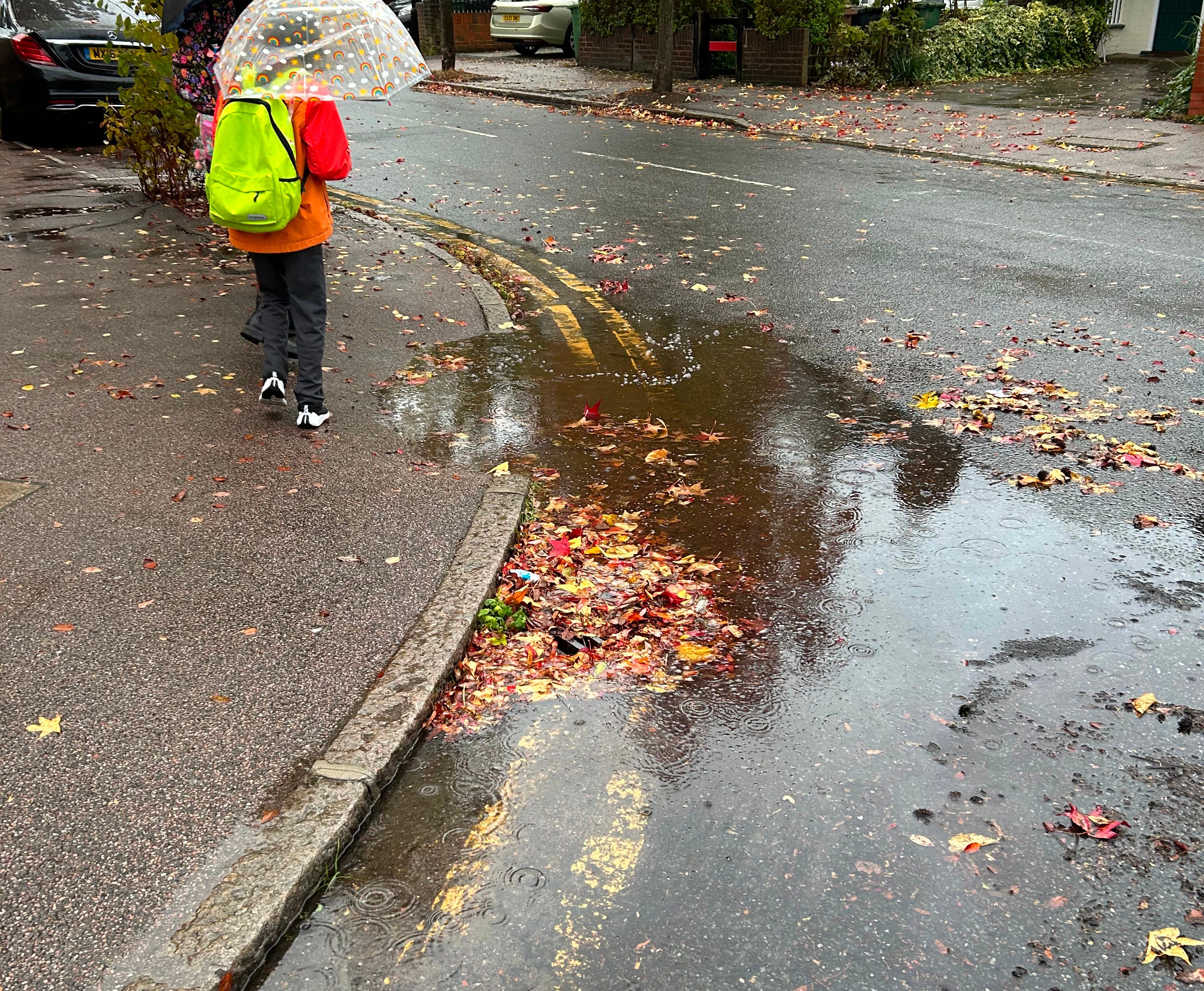
Would anyone design a system like this?
Part of the reason surface water flooding is so hard to make sense of is that the system we have to manage it is… complex. I’ve spent the last few years becoming an expert in a niche and deeply unintuitive topic: the governance of surface water in London. Or, more plainly, who is responsible for the water that falls from the sky once it hits the ground.
Here is an abbreviated version of my findings. If rain falls on my garden, it’s my responsibility. If it falls on the pavement or the road outside my house, it’s the responsibility of my local authority, unless the road is managed by Transport for London (TfL), in which case it’s theirs. While water is in my downpipes and the pipes on my property, it’s still my problem. Once it enters a shared drain or a public sewer, congratulations Thames Water, it’s all yours. Water that falls on the street and enters a gully under the road? Still the local authority or TfL. Until it reaches the sewer. Then it’s over to Thames Water again.
You live near a river you say? This isn’t my main area of expertise but here’s what I know. If it’s small, it’s likely an “ordinary watercourse” and the responsibility of the local authority. If it’s a “main river”, it’s the Environment Agency. And if there’s a watercourse running through your land, lucky you: you’re a “riparian owner”, with legal responsibility to maintain it.
I’m not explaining this because I think everyone should understand it in detail. I’m explaining it because it shows why so few people do. When surface water flooding happens, most people are just looking for someone to help. And then, later, for someone to blame. But there is no obvious helper, nor an obvious culprit and definitely no easy answers. Nature resists our efforts to contain her within governance frameworks, moving easily across the boundary lines we rely on to organise responsibility.
Process and sense making
So how do we convince people that their actions or inactions are connected to the problem? How do we motivate people to act when the payoff is invisible, delayed, and shared? In my strategy work, I talk a lot about the importance of process as well as product. Process matters because it’s the space where stories are formed, tested, and gradually owned together. When flooding happens, people don’t just want a fix; they want an explanation. They want to understand what happened, why it happened, and what will stop it happening again. If we can’t offer a shared way of making sense of those questions, people will create their own explanations.
What we need is the space and time to build shared understanding and with it, a collective view of what has happened, where we want to go next and how to get there. I am drawn back to the work of John Forester and his theory of communicative planning, which describes planning and design as “a social process of making sense together in practical conversations.”
For a talk earlier this year, I looked into the origins of the word community. It comes from common, and originally referred to groups of people with shared obligations or collective responsibility for something. Over time, the word has shifted to mean social ties or shared identity. Now we often use it to describe people linked by geography. But proximity doesn’t equal community.
My community is never going to agree on everything. But maybe next time we can do more to create the conditions where we can make sense of what’s happening together, even when we value different things. And through that process, we might begin to find a shared purpose, a shared understanding, or a project we can hold in common.